Takes 20 seconds. The PDF lands on WhatsApp and email.
No spam. A counsellor may call once to help you pick a batch.
How do we reach you?
Takes 20 seconds. No obligation.
We never share your number.
Your details
Takes 20 seconds.
We never share your number.
Link copied
Digital Marketing Salary in India After a Course: Fresher to 3 Years, Role by Role
Real 2026 digital marketing salary in India by role: fresher to 3 years, Mohali and Chandigarh vs metros, and the path from ₹2.6 lakh to ₹5 lakh plus.
S
Author: Shiva Ji|22 min read|September 14, 2026
In this article
Digital Marketing Salary in India After a Course: Fresher to 3 Years, Role by Role
The median digital marketing salary in India for a fresher is ₹2.6 lakh a year. The top 10% of freshers in the same role, in the same year, earn ₹3.9 lakh. The top 1% earn ₹7.5 lakh. Those three numbers come from the same 6,700 salary profiles on AmbitionBox, and the gap between them has nothing to do with which college you went to.
If you are finishing a digital marketing course, or deciding whether to start one, the question you actually want answered is not “what is the average salary”. It is “what will I earn in year one, and what do I have to do to be earning double by year three”. Most salary guides skip that part. They list averages by role and city and leave you to guess how anyone moves between them.
This guide uses live 2026 salary data for eight roles, with separate figures for 0 to 1, 1 to 3 and 3 to 6 years of experience, plus city figures for Mohali and Chandigarh that no other guide publishes. Then it shows you the path from a first offer to a ₹5 lakh plus salary in three years, and the habits that keep most people stuck at ₹3 lakh.
TL;DR
Fresher pay after a digital marketing course clusters around ₹2.4 to 2.8 lakh a year in most roles; the top 10% start at ₹3.9 lakh.
By the 3 to 6 year band, Digital Marketing Executives average ₹4 lakh, Digital Marketing Specialists ₹5.8 lakh, and Performance Marketing Managers ₹12.3 lakh.
Paid media roles pay the most at every stage; SEO Executive roles pay the least on average but have the widest top-end spread.
Mohali and Chandigarh freshers earn ₹2.4 to 2.5 lakh, within 10% of Delhi and Mumbai, on far lower living costs.
What moves you from the median to the top 10% is proof of results, one specialisation, and a written record of the numbers you changed.
Year three is where salaries split: people who own a budget reach ₹5 to 9 lakh, people who only run tools stay near ₹3.5 lakh.
What is the digital marketing salary in India for a fresher after a course?
Three freshers, same job title, same year. The difference is what they can prove.
a) The median: ₹2.6 lakh a year
Start with the most common first job. AmbitionBox lists 47,000+ salary reports for the title Digital Marketing Executive in India, which makes it the largest sample for any marketing role in the country. For people with 0 to 1 year of experience, the average is ₹2.6 lakh a year, with a typical band of ₹2.5 to 2.8 lakh. That is roughly ₹21,000 a month before deductions.
Other entry roles land close by. A fresher SEO Executive averages ₹2.1 lakh, a Social Media Executive ₹2.7 lakh, and a Content Writer ₹2.8 lakh. Nobody should be surprised by these numbers. They are the going rate for someone who has completed training and has not yet produced a measurable result for an employer.
b) The top 10%: ₹3.9 lakh with the same experience
The more useful number is the top 10% figure for the same experience band. Among freshers with the Digital Marketing Executive title, one in ten earns ₹3.9 lakh or more. For Content Writers it is ₹4.3 lakh, for Social Media Executives ₹4 lakh. These people have the same years of experience as everyone else in the sample, which is zero. What they have is something to show: an internship where they ran a real campaign, a portfolio site that ranks, a client project with before and after numbers. Employers pay 50% more for a fresher who removes the risk of hiring a fresher.
c) The honest answer: a range, decided during the course
So the honest answer to “what will I earn after a digital marketing course” is a range, not a number: ₹2.4 to 3.9 lakh in year one, and where you land inside that range is decided during the course, not after it. A course that ends with a certificate puts you at the bottom of the band. A course that ends with live projects and a case study puts you in the top third.
💡
Pro Tip
Ask any institute for the average first salary of its last batch, not its best one. If they cannot tell you, assume the median figure of ₹2.6 lakh and plan from there.
Digital marketing salary in India by role: which pays the most in the first three years?
Salary by experience band for five common roles. Paid media climbs fastest.
Job titles in digital marketing are not interchangeable, and the digital marketing salary gaps between them are larger than most course brochures admit. Here is what the 2026 data shows for the 1 to 3 year band, which is where you will spend most of your first three years:
a) The 1 to 3 year figures, role by role
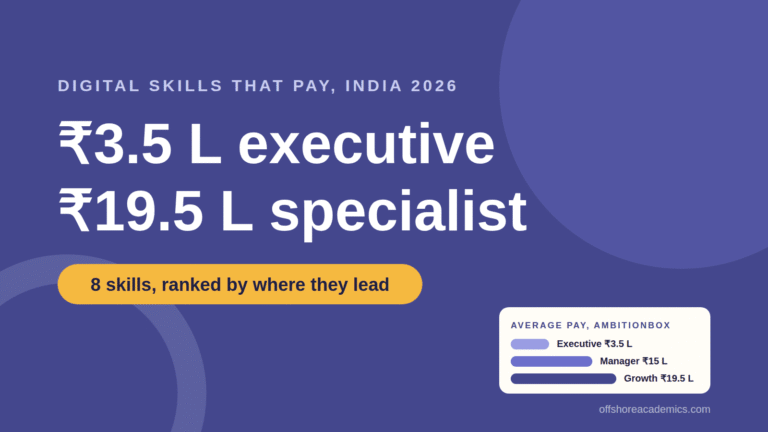
Performance Marketing Manager averages ₹9.5 lakh at 1 to 3 years, from 163 reported salaries. Digital Marketing Manager averages ₹6.1 lakh from 1,800 reports. Digital Marketing Specialist averages ₹4.2 lakh. Email Marketing Specialist averages ₹3.8 lakh. PPC Executive averages ₹3.3 lakh, Content Writer ₹3.3 lakh, Social Media Executive ₹3.2 lakh, Digital Marketing Executive ₹3 lakh, and SEO Executive ₹2.5 lakh.
b) Why paid media and channel ownership pay more
Two things stand out. First, anything with “performance” or “paid” in the title pays more, because the person is directly responsible for money. A performance marketer who manages ₹20 lakh a month of ad spend and returns ₹80 lakh in revenue has a salary conversation that an SEO executive never gets to have, even if the SEO work is harder. Second, the word “Manager” or “Specialist” in a title at 1 to 3 years is not about seniority. It signals that the person owns a channel rather than executing tasks inside one.
The same person doing the same work can be paid ₹3 lakh as an Executive or ₹4.2 lakh as a Specialist, depending on how the role was scoped when they were hired.
c) A note on SEO: lowest average, widest top end
SEO deserves a specific note because it is the most popular entry point and the lowest paid on average. The 20,000 SEO Executive salaries on AmbitionBox average ₹2.7 lakh across 0 to 4 years. But the top 1% of SEO Executives at 3 to 6 years earn ₹8.1 lakh, three times the average. SEO pays poorly for link builders and keyword-tool operators. It pays well for the small group who can show organic revenue growth for a business. If you choose SEO, whether through an SEO certification course or on the job, choose it knowing that the money is in the results, not the title.
d) Content writing: the quiet performer
Content Writing is the quiet performer. It starts higher than SEO and social, reaches ₹4.4 lakh by 3 to 6 years, and the top 1% reach ₹13.5 lakh. Writers who understand search intent and conversion copy move into content strategy roles that pay like paid media roles.
What separates a ₹2.6 lakh fresher from a ₹3.9 lakh fresher?
Your salary band tells an employer what you can prove, not how long you have worked.
Read enough digital marketing salary reports and a pattern appears. Salaries in the first three years fall into four zones, and each zone corresponds to what the person can demonstrate, not to their years of experience.
a) ₹2 to 3 lakh: the generalist zone
The ₹2 to 3 lakh zone is the generalist zone. You know the tools. You can set up a Meta campaign, write a meta description, schedule a month of posts. What you cannot do is point at a number and say “I moved that”. Most freshers start here, and most people who stay generalists remain here into their third year.
b) ₹3 to 4.5 lakh: the specialist zone
The ₹3 to 4.5 lakh zone is the specialist zone. You own one channel end to end. If it is paid social, you write the creative brief, build the audiences, manage the budget, read the reports and change things weekly. Employers pay more here because they can hand you a channel and stop thinking about it. Reaching this zone in year one is realistic if your course forced you to specialise instead of touring every subject for a week each.
c) ₹4.5 to 7 lakh: the proven zone
The ₹4.5 to 7 lakh zone is the proven zone. You have numbers on a page: “Grew organic leads from 40 to 130 a month in eight months”, “Cut cost per lead from ₹410 to ₹190 across ₹12 lakh of spend”. These sentences are worth more than any certification, and they are the only thing that gets you a 40% jump when you switch jobs at the two-year mark.
d) ₹7 lakh and above: the revenue owner zone
The ₹7 lakh and above zone is the revenue owner zone. Someone trusts you with a budget and judges you on returns. Performance Marketing Managers sit here from year one of holding the title, which is why their 1 to 3 year average is ₹9.5 lakh while a Digital Marketing Executive with identical tenure averages ₹3 lakh.
e) What is not on the list
Notice what is not on this list: college name, number of certificates, years of experience. Those matter for a first interview. They stop mattering the moment you have a result to talk about instead.
KEY TAKEAWAYS
Your salary zone is set by what you can prove, not by how long you have worked.
Owning one channel end to end moves you from ₹2.6 lakh to ₹3.5 lakh territory, often within the first year.
Written results with before and after numbers are what open the ₹4.5 lakh plus zone at a job switch.
Budget ownership is the only reliable route above ₹7 lakh before year four.
How do digital marketing salaries in Mohali and Chandigarh compare with Delhi and Mumbai?
Tricity pay sits within 10% of the metros at every experience band.
a) Mohali and Chandigarh: the actual figures
Most salary guides tell you Mumbai and Bengaluru pay the most and stop there. The city data for Digital Marketing Executives is more interesting than that. In Mohali (listed on AmbitionBox as Sahibzada Ajit Singh Nagar), freshers average ₹2.4 lakh, the 1 to 3 year band averages ₹3 lakh, and the 3 to 6 year band averages ₹4.1 lakh. Chandigarh runs at ₹2.5, ₹3.1 and ₹3.9 lakh for the same bands.
b) Delhi and Mumbai: a 5 to 15% premium
Now compare New Delhi, where the typical range across 0 to 5 years is ₹3.4 to 3.7 lakh, and Mumbai at ₹3.6 to 4 lakh. The metro premium for an executive-level digital marketing job is somewhere between 5% and 15%. Rent for a one-bedroom flat in Mumbai or south Delhi costs two to three times what it costs in Mohali. In take-home terms, a Tricity digital marketer at ₹3 lakh often keeps more money at the end of the month than a Mumbai marketer at ₹3.5 lakh.
c) Why the gap is so small
There are two reasons the gap is small. The Tricity has become an agency hub: Mohali, Chandigarh and Panchkula host hundreds of digital agencies and IT services firms serving clients in the US, UK, Canada and Australia, and those clients pay in dollars and pounds. An agency billing a US client $2,000 a month for SEO can afford to pay a Mohali executive the same as a Delhi agency billing an Indian client ₹40,000 a month. The second reason is remote work. A meaningful share of Tricity marketers now work for companies in other cities at those companies’ pay scales.
d) What this means for where you start
The practical takeaway for anyone choosing where to study and start: you do not need to move to a metro to earn a metro salary in digital marketing. You need to work for a company whose clients are in a higher-paying market. That is also why agency experience with international clients converts so well when you later negotiate.
One caution on the local data. The Mohali sample is 100 plus profiles and the Chandigarh sample is 300 plus, against 6,600 for Delhi. Treat the Tricity figures as directional. They line up with what agencies here actually offer, which is the useful part.
Digital marketing salary in India by role and experience, 2026
Role
0 to 1 year
1 to 3 years
3 to 6 years
Top 10% (1 to 3 yrs)
SEO Executive
₹2.1 L
₹2.5 L
₹3.3 L
₹3.5 L
Digital Marketing Executive
₹2.6 L
₹3.0 L
₹4.0 L
₹4.3 L
Social Media Executive
₹2.7 L
₹3.2 L
₹4.0 L
₹4.5 L
Content Writer
₹2.8 L
₹3.3 L
₹4.4 L
₹5.0 L
PPC Executive
n/a
₹3.3 L
₹3.9 L
₹4.8 L
Email Marketing Specialist
n/a
₹3.8 L
₹7.3 L
₹6.0 L
Digital Marketing Specialist
n/a
₹4.2 L
₹5.8 L
₹6.0 L
Digital Marketing Manager
n/a
₹6.1 L
₹7.2 L
₹9.8 L
Performance Marketing Manager
n/a
₹9.5 L
₹12.3 L
₹18.0 L
All figures are average annual salaries from AmbitionBox role profiles, read in September 2026. “n/a” means AmbitionBox does not publish a 0 to 1 year band for that title because almost nobody is hired into it as a fresher. Top 10% is the figure for the 1 to 3 year band, which is the most useful benchmark for someone one to two years out of a course.
Agency, in-house or freelance: which pays more after a digital marketing course?
Three routes, three different pay curves. Most high earners have done two of them.
Where you work shapes your digital marketing salary curve as much as what you do. Here is what the three routes look like from inside an agency that has hired for all of them.
a) Agency: lowest year-one pay, fastest learning
Agencies pay the least in year one and teach the most. A junior at a mid-sized agency touches four to eight client accounts in a year, across industries and budgets, and learns in twelve months what an in-house marketer learns in three years. Starting pay in Tricity agencies runs ₹2.2 to 3.2 lakh. The jump comes at 18 to 24 months, when the person has enough client results to either be promoted to account ownership or to leave for an in-house role at a 30 to 50% raise.
Agencies with international clients are the best version of this route, because you learn to report to clients who measure everything in cost per acquisition.
b) In-house: higher pay, slower range
In-house roles pay 10 to 20% more at the same level and move slower. You work on one brand with one budget, you go deeper on fewer channels, and your growth depends on the company growing. In-house is the better choice at the two-year mark, when you already have range and want depth and stability. It is the worse choice as a first job, because a fresher in-house often becomes the person who does everything and masters nothing.
c) Freelance: most per hour, least per month at first
Freelancing pays the most per hour and the least per month until you have a portfolio. Indian freelancers with proven paid media or SEO results charge international clients $15 to $40 an hour on platforms like Upwork, which is ₹1.2 to 3.3 lakh a month at full utilisation. Almost nobody reaches full utilisation in year one. The realistic path is a full-time job for two years while building two or three freelance clients on the side, then a decision at year three about which one to keep.
⚠ Avoid This
Do not start freelancing straight out of a course with no case studies. You will compete on price with thousands of people doing the same, win work at $3 an hour, and learn nothing you can use in a job interview. Two years of agency results first, then freelance.
d) The combination that pays the most
The highest earners we see at three years have usually done two of the three routes: agency first for range, then in-house for a pay jump, with freelance clients running alongside. That combination is what produces a ₹7 lakh plus salary plus ₹1 lakh a month of side income by year three.
What does the three-year path from a first job to ₹5 lakh plus look like?
The year two decision, adding a second skill and tracking results, is what most people skip.
Here is the path, year by year, built from the salary bands above and from what actually happens to course graduates who reach the top of them.
a) Year one: get placed and own one channel
Your target is a role, not a salary. Take the job that gives you a channel to own, even at ₹2.4 lakh, over the job that pays ₹3 lakh to be a coordinator. By month six you should be the person who runs, say, Google Ads for three clients, and you should be able to say what changed because of you. By month twelve your target is ₹3 to 3.5 lakh, either through an internal raise or an offer from somewhere else. Both are common at twelve months for people with a channel and a result.
b) Year two: add a second skill and write things down
If you own paid social, learn Google Ads or conversion tracking. If you own SEO, learn content strategy or technical SEO. Two adjacent skills make you a specialist; one skill makes you a replaceable executive. If you are not sure which skill to add, start with the digital skills that raise salaries fastest. This is also the year to keep a results file: every campaign, every before and after number, every screenshot of a dashboard that moved. Nobody remembers their results from eighteen months ago at interview time unless they wrote them down. Target by the end of year two: ₹3.5 to 5 lakh, with a specialist title.
c) Year three: own a budget, then switch or negotiate
The single biggest salary event in a digital marketing career is the first job switch with proof in hand. Switches at the two to three year mark with documented results routinely produce 40 to 60% raises, taking a ₹4 lakh specialist to ₹6 to 6.5 lakh. If you have been trusted with a monthly budget by then, the Performance Marketing and Digital Marketing Manager bands open up, with 1 to 3 year averages of ₹9.5 and ₹6.1 lakh. If you stay, you negotiate with the market rate for your results, not with your last salary. Target by the end of year three: ₹5 to 9 lakh.
That digital marketing salary range is wide on purpose. The people at ₹5 lakh followed the path but stayed at the same company. The people at ₹9 lakh followed the path, switched once with numbers, and picked a paid media specialisation. Both outcomes are far above the ₹3.5 lakh that people who never left the generalist zone report at three years.
💡
Pro Tip
Set a calendar reminder for month 22. That is when you update your results file, check the market rate for your role on AmbitionBox and LinkedIn, and decide whether year three is a negotiation or a switch. People who decide at month 22 earn more than people who wait to be noticed.
Which mistakes keep digital marketing salaries flat for years?
Five habits, all fixable, that explain most of the people stuck at ₹3 lakh in year three.
The 3 to 6 year band for Digital Marketing Executives averages ₹4 lakh. That means thousands of people with four or five years of experience are earning what a strong fresher earns. Their digital marketing salary went flat for reasons that were visible in year one.
a) Learning tools without a live project
Knowing Meta Ads Manager is not a skill; it is a prerequisite. Employers hire for judgement, which only develops when your decisions cost real money. If your course has you practising on demo accounts, your first job will be your actual training, and you will be paid accordingly.
b) Staying a generalist past year one
Being “good at digital marketing” is like being “good at medicine”. Nobody hires it. Every high salary in the data belongs to a specific title: performance marketing, email, content strategy, SEO. Pick one by the end of your course and go deep.
c) Never writing down the numbers you moved
This is the most common and the most expensive. You ran a campaign in March that cut cost per lead by 40%. By next February you cannot remember the numbers and cannot prove it. Keep the results file. Update it monthly.
d) Accepting the first offer without a counter
Freshers routinely accept the first number because they are relieved to have an offer. A polite counter of 10 to 15%, backed by one specific result from your course projects, succeeds more often than it fails, and it resets the base that every future raise is calculated on. A ₹30,000 difference in year one compounds into several lakh over five years.
e) Waiting for a raise instead of checking the market
Internal raises in Indian agencies average 8 to 12% a year. Job switches with results average 40% plus. The people who stay eight years and wonder why they earn ₹5 lakh never once checked what their skills were worth outside.
⚠ Avoid This
Never quote your current salary as the basis for a new offer. Quote the market rate for the results you can prove. The moment you anchor to your last salary, you cap the raise at whatever percentage the employer thinks is reasonable, usually 15 to 20%, instead of the 40 to 60% that a documented switch produces.
How does the digital marketing course you choose change the salary you get?
Six things that decide whether your first offer is ₹2.4 lakh or ₹3.5 lakh.
Everything above points back to one moment: what you walk out of your course with. The course does not decide your salary in year three. It decides where you start, and starting at ₹3.5 lakh instead of ₹2.4 lakh means every later step happens from a higher base.
a) Live client projects
Not simulations, not demo accounts with fake budgets, but campaigns for real businesses where the spend and the outcome are real. This is the difference between an institute and an agency that trains. Ask to see a project from the last batch and ask what the result was.
b) The tools you will be interviewed on
GA4, Google Search Console, Google Ads, Meta Ads Manager, a rank tracker, an email platform. These are the tools you will be interviewed on. A course that spends its time on theory and leaves tools to a final week produces graduates who freeze in the practical round.
c) One specialisation by month two
A course that tours every subject for a week produces generalists, and generalists start in the ₹2 to 3 lakh zone. A course structured as a major and a minor, where you pick SEO or paid media or social early and go deep, produces specialists who start higher. That is how the Offshore Academics digital marketing course is built, with a major and a minor chosen in the first weeks.
d) A portfolio you own
By the end of the course you should have two or three case studies with before and after numbers, on a site or a document that is yours, not the institute’s. This is the results file described earlier, started early.
e) Placement support that is measured
“100% placement assistance” means nothing. Ask how many people from the last batch were placed, in which companies, and at what median salary. An institute that tracks these numbers will tell you, and will usually publish a placements page with names and companies. One that does not track them will change the subject.
f) Trainers who still practise
Digital marketing changes every quarter. A trainer who ran their last campaign in 2022 is teaching history. A trainer who is managing client accounts this month is teaching what interviewers will ask. Training that runs inside a working agency, where students sit next to people running live campaigns, is the strongest version of this.
g) How to weigh the fee
Weigh a course on those six points and the fee becomes a secondary question. A ₹40,000 course that starts you at ₹2.4 lakh costs you more than a ₹90,000 course that starts you at ₹3.5 lakh, and the difference keeps compounding for years.
The short version: digital marketing salary in India, year one to three
The digital marketing salary in India after a course starts at a median of ₹2.6 lakh for a fresher and reaches ₹4 lakh at the 3 to 6 year mark for the same title. Those are the numbers for people who do the average thing. The top 10% start at ₹3.9 lakh, reach ₹5 to 6 lakh in the 1 to 3 year band as specialists, and cross ₹9 lakh as performance marketers, and the data shows they do it with the same years of experience as everyone else.
The difference is not talent and it is not the metro you live in; Mohali and Chandigarh sit within 10% of Delhi. It is four decisions: specialise in one channel early, keep a written record of the results you produce, add a second adjacent skill in year two, and switch or negotiate at year three with numbers rather than with your last salary. Every one of those decisions is available to you, and the first one is available today, when you choose a course.
If you want to see what training inside a working agency looks like, with live client projects, a major and minor structure, and trainers who are running campaigns for US, UK, Canadian and Australian clients this quarter, Offshore Academics in Mohali runs 45, 90 and 180 day programs on exactly that model. Come and sit in on a class before you decide anything.
Frequently asked questions
What is the salary of a digital marketing fresher in India after a course?
A fresher Digital Marketing Executive in India earns an average of ₹2.6 lakh a year, based on 6,700 salary reports on AmbitionBox for the 0 to 1 year experience band. The typical range is ₹2.5 to 2.8 lakh. The top 10% of freshers in the same role earn ₹3.9 lakh or more, and they are the ones who leave their course with live project results and a specialisation rather than a certificate alone. Other entry roles are close: SEO Executive at ₹2.1 lakh, Social Media Executive at ₹2.7 lakh and Content Writer at ₹2.8 lakh.
Which digital marketing job has the highest salary in India for someone with 1 to 3 years of experience?
Performance Marketing Manager pays the most at 1 to 3 years, averaging ₹9.5 lakh a year, followed by Digital Marketing Manager at ₹6.1 lakh and Digital Marketing Specialist at ₹4.2 lakh. All three titles involve owning a budget or a channel rather than executing tasks inside one. Paid media roles pay more at every experience level because the person is directly accountable for money spent and revenue returned, which makes their results easy to measure and easy to negotiate on.
How much does a digital marketer earn in Mohali or Chandigarh compared to Delhi?
A Digital Marketing Executive in Mohali averages ₹2.4 lakh as a fresher, ₹3 lakh at 1 to 3 years and ₹4.1 lakh at 3 to 6 years. Chandigarh figures are ₹2.5, ₹3.1 and ₹3.9 lakh for the same bands. New Delhi runs at a typical ₹3.4 to 3.7 lakh across 0 to 5 years, so the metro premium is roughly 5 to 15% while rent in Delhi costs two to three times more. Tricity agencies serving US, UK and Australian clients are the main reason local pay stays close to metro pay.
Can I get a ₹5 lakh salary in digital marketing within 3 years?
Yes, and the data shows it is common for people who specialise. Digital Marketing Specialists average ₹4.2 lakh at 1 to 3 years with the top 10% at ₹6 lakh, and Digital Marketing Managers average ₹6.1 lakh in the same band. The usual route is one channel owned in year one, a second adjacent skill and a written results file in year two, and a job switch or negotiation in year three backed by those numbers. Switches with documented results typically produce 40 to 60% raises, which takes a ₹3.5 to 4 lakh salary past ₹5 lakh.
Does a digital marketing certification increase salary?
A certification on its own rarely changes an offer. Employers pay for proof of results, and the salary data reflects that: freshers with identical experience are paid anywhere from ₹2.5 to 7.5 lakh depending on what they can show. A course increases your salary when it gives you live client projects, tools you will be interviewed on, one specialisation, and a portfolio with before and after numbers. Google and Meta certifications help you pass screening. Case studies are what move the number.
Is SEO or paid ads better for salary in India?
Paid ads pay more on average at every stage. A PPC Executive averages ₹3.3 lakh at 1 to 3 years against ₹2.5 lakh for an SEO Executive, and Performance Marketing Managers reach ₹9.5 lakh in the same band. SEO has a lower average but a wide top end: the top 1% of SEO Executives at 3 to 6 years earn ₹8.1 lakh, three times the average. If you want the fastest salary growth, choose paid media. If you choose SEO, focus on organic revenue results rather than rankings, because that is what the top earners in SEO are paid for.
.webp)