Takes 20 seconds. The PDF lands on WhatsApp and email.
No spam. A counsellor may call once to help you pick a batch.
How do we reach you?
Takes 20 seconds. No obligation.
We never share your number.
Your details
Takes 20 seconds.
We never share your number.
Link copied
How to Start Digital Marketing for Beginners in 2026: Zero to First Job in 90 Days
A 90 day plan for digital marketing beginners in 2026: what to learn first, where free learning stops, one live project, the certifications that matter, and what your first job pays.
S
Author: Shiva Ji|19 min read|September 14, 2026
In this article
If you want to know how to start digital marketing as a beginner in 2026, here is the honest version: you do not need a degree, a big budget or a year of study. You need about 90 days, one channel, and one project with a real number at the end of it. Digital advertising in India is now a ₹93,156 crore market, larger than every traditional medium combined, and there are 33,420 listings on Naukri open to people with zero experience as I write this. Employers are not short of beginners. They are short of beginners who can show a result.
This guide is the plan we give students on day one at Offshore Academics, written out in full. It covers what digital marketing actually means now that AI runs half of every ad platform, what to learn first and what to ignore, where free learning stops working, a 90 day roadmap with a live project inside it, how to get experience with no job and no clients, which certifications matter, what your first job pays, and the five mistakes that keep beginners stuck at the starting line. Nothing here needs money you do not have. A few parts need ₹300 a day for two weeks.
TL;DR
Digital marketing for beginners comes down to six channels: search (SEO and paid), social, content, email, and analytics tying them together. A beginner learns the customer journey first, then picks one channel.
India’s digital ad spend grew 22% in 2025 to ₹93,156 crore, 60% of all advertising, and is forecast at about ₹1.12 lakh crore in 2026. The jobs follow the money.
Free learning (Google Skillshop, Meta Blueprint, HubSpot Academy) gets you vocabulary and certificates. It does not give you a live campaign, feedback, or a result for your CV.
The 90 day plan: days 1 to 30 foundation and accounts, days 31 to 60 one channel and one real project, days 61 to 90 a written case study and twenty applications.
Your first job is usually Digital Marketing Executive, SEO Executive or Social Media Executive at ₹2.1 to 2.8 lakh. Freshers with a documented project start closer to ₹3.9 lakh.
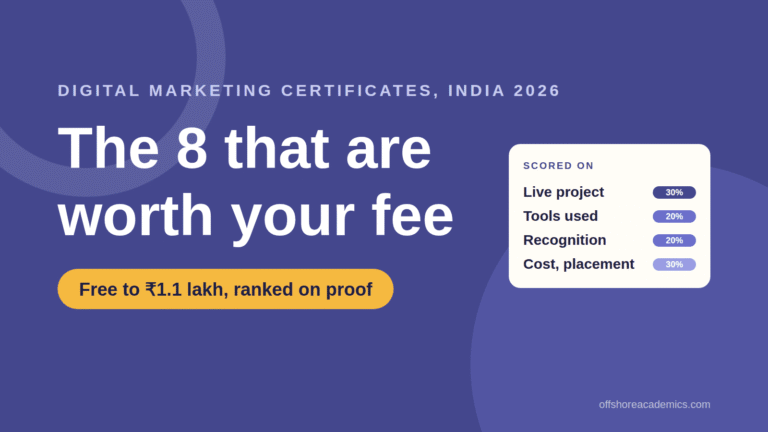
A course is worth paying for only if it gives you live client work, the tools you will be interviewed on, one specialisation, and placement numbers it is willing to show you.
What does digital marketing actually mean in 2026, and what jobs does it lead to?
Digital passed traditional media in India in 2024 and the gap is widening every year.
Digital marketing is every way a business finds and keeps customers through a screen. In practice it comes down to six channels: search engine optimisation, which earns visits from Google without paying per click; paid ads on Google, Meta and YouTube; social media, both organic posting and community; content, meaning the pages, videos and emails that do the persuading; email and WhatsApp marketing, which bring people back; and analytics, which measures all of it. Everything else you will hear about, from influencer marketing to marketplace ads, is a variation of one of those six.
a) The money is moving to digital, quickly
The Pitch Madison Advertising Report 2026 puts India’s total ad market at ₹1,55,105 crore for 2025, up 12% on the year. Digital accounted for ₹93,156 crore of that, a 60% share, and grew 22% while traditional media shrank 1%. The same report forecasts a ₹1,74,605 crore market in 2026 with digital at roughly 64%. When 22% more money moves through Google, Meta and YouTube every year, someone has to plan it, run it, write for it and report on it. That someone is the job you are training for.
b) What has changed since the guides written in 2024
Two things. First, AI now sits inside every platform. Google Ads decides bids and writes headline variations, Meta picks audiences for you through Advantage+, and every social tool drafts captions. This has not removed the beginner job. It has changed it. The person who only knew how to click through Ads Manager has been automated. The person who can tell whether the automation is producing good customers, and change the inputs when it is not, has become more valuable. Second, the search results page itself has changed.
AI Overviews answer many questions before a user clicks, so SEO in 2026 is as much about being cited as being ranked. A beginner who understands both shifts is ahead of most people who learned five years ago and stopped.
c) The jobs a beginner is actually hired for
The entry titles are Digital Marketing Executive, SEO Executive, Social Media Executive, PPC or Performance Marketing Executive, and Content Writer. On Naukri, on 14 September 2026, 2,45,032 listings mention digital marketing and 33,420 of them accept candidates with zero years of experience. Delhi NCR, Mumbai and Bengaluru carry the most, but agencies in Mohali and Chandigarh hire freshers every quarter to work on US, UK and Australian accounts, which is why local pay in the Tricity sits within 10% of Delhi. We cover the full numbers in our digital marketing salary in India guide.
How to start digital marketing: what should a beginner learn first?
Start with the channel that fits how you already think. You can add a second one in year two.
Most digital marketing for beginners guides list twelve channels and tell you to learn all of them. That is how you end up three months in, able to define everything and do nothing. Learn in this order instead.
a) The customer journey, before any channel
Every channel exists to move a person from “never heard of you” to “paid you” to “came back”. Search catches people who already want something. Social and video create the want. Content answers the doubts. Email and WhatsApp bring them back. Analytics tells you which step is leaking. Spend your first week understanding that flow with one real business in mind, ideally a local one you can walk into. Once you can explain why a dentist in Mohali gets patients from Google Maps and a clothing brand gets them from Instagram, every tool you learn afterwards has somewhere to sit.
b) Pick one first channel, using the map above
Then pick one channel and go deep for sixty days. Paid ads give the fastest feedback: you can run a campaign on Monday and know by Friday whether it worked. Paid also pays best at entry, with a PPC Executive averaging ₹3.3 lakh at 1 to 3 years against ₹2.5 lakh for an SEO Executive. SEO is slower and cheaper to practise, and it suits people who like writing and patience. Social suits people who like making things and reading comments. Content suits people who already write every day. There is no wrong first pick, only a wrong number of picks, which is more than one.
c) The tools you must be able to open without fear
Whatever channel you pick, by the end of month one you should have opened and used: Google Analytics 4, Google Search Console, Google Ads (a real account, even with no spend), Meta Ads Manager, one keyword tool, and a website you control. Interviewers in 2026 do not ask you to define a bounce rate. They put a GA4 screen in front of you and ask what happened last month. If your course leaves tools to the final week, you will freeze in that round. Our digital marketing course puts students inside live accounts in week one for this reason.
💡
Pro Tip
Create a Google Ads account and a Meta Ads Manager account today, even if you never spend a rupee this month. Both are free, and clicking through real menus for ten minutes a day teaches more than any video about them.
Can you learn digital marketing for free, and where does free stop working?
Free is a good first month. It is a bad sixth month.
Yes, you can learn the theory of digital marketing for free, and in 2026 the free material is better than most paid courses were five years ago. Use it. Just know what it is for.
Vocabulary, so that job descriptions stop looking like another language. Platform certificates, which get you past the first screening filter. Tool walkthroughs, so that the menus are familiar. And other people’s case studies, which show you what a good result looks like. Do all of it in month one. It costs nothing and it is the foundation.
b) Where free stops
Free does not give you a campaign with real money in it, someone experienced looking at your work and telling you what is wrong, a result you can describe in an interview, or a conversation with anyone who hires. Those four things are the whole difference between a certificate holder and an employable beginner, and every one of them costs either money or access. You can buy the first with ₹300 a day of your own ad spend. The other three are what a good course sells, and the only reason to pay for one.
c) When paying makes sense
Pay for a course when you have finished the free month, you have picked a channel, and you want the live project, the feedback and the placement conversation compressed into 45 to 90 days instead of a year of trial and error. Do not pay for recorded videos of things Skillshop already teaches. Our course list is built around that split: the theory is assumed, the time is spent on client work.
How to start digital marketing in 90 days: the plan
Three phases, each with an output you can show someone.
Here is the plan for how to start digital marketing from zero. It assumes 10 to 15 hours a week. If you are in a full time course, the same phases happen in 45 to 90 days with a trainer checking each output.
a) Days 1 to 30: foundation and accounts
Week one is the customer journey, studied through one real business. Weeks two and three are the free certifications: Google Ads Search and GA4 on Skillshop, the Meta Blueprint fundamentals, one HubSpot course. Week four is setup: your own site live on a ₹300 a month host, GA4 and Search Console connected to it, a Google Ads account and a Meta Ads Manager account created. Output at day 30: two certificates and a website you own that you can measure.
b) Days 31 to 60: one channel and one live project
Pick your channel and run one project with a real outcome. If paid: ₹300 a day for 14 days promoting your own site, a friend’s business or a local shop, with a conversion you can count, even if it is WhatsApp messages. If SEO: ten pages targeting ten low competition local queries, with rankings tracked weekly. If social: 30 days of daily posting for one small account with a follower and enquiry goal. If content: four long pieces on your own site with search traffic as the score. Output at day 60: a number that changed because of you.
c) Days 61 to 90: proof and applications
Write the project up as a one page case study using the structure in the next section. Put it on your site with your name on it. Update your LinkedIn headline to the channel you chose, not “aspiring digital marketer”. Then send twenty tailored applications, each one referencing the case study. Interviews come from proof, not from volume. Output at day 90: a portfolio page, a results file and a first round of interviews. If you want to see what the first year after that looks like, read our guide to the digital skills that raise salaries fastest.
⚠ Avoid This
Do not extend the foundation phase. Beginners who spend four months “getting ready” are usually avoiding the moment when their work can fail in public. It can. That is the point. A failed ₹4,200 campaign with a written explanation of why is a better interview story than any certificate.
How do you get real experience with no job and no clients?
One page. Four parts. Real numbers, however small.
This is the question that separates digital marketing beginners who get hired in three months from beginners who are still applying after a year. Experience is not a thing that happens to you. It is a thing you arrange.
a) Your own site is client number one
A site you control is a lab. You can test titles, run ads to it, watch GA4, break things and fix them. It also becomes the home of your portfolio. Total cost: a domain and basic hosting, under ₹2,500 for the year.
b) ₹300 a day is a real budget
Fourteen days at ₹300 is ₹4,200. That is enough to run a Google Search campaign for a narrow local service and see real clicks, real cost per click and real enquiries. It is also enough to learn the thing no free course teaches: how it feels to watch your money disappear at ₹38 a click on a keyword you should have excluded. Everyone who runs ads professionally learned that lesson with someone’s money. Learn it with ₹4,200 of your own.
c) A local business will say yes
Walk into a nearby clinic, gym, tuition centre or restaurant and offer to set up and run their Google Business Profile, their Instagram, or a small ads campaign free for a month, in exchange for permission to publish the results. Most small businesses have nobody doing this. Set one measurable goal, agree it in writing, and treat it like a paid account. This is exactly how our students work inside live agency accounts, and it is the reason employers read their CVs differently.
d) Write it down while it is happening
Keep a results file from day one: date, what you changed, what the number was before, what it was after. Screenshots go in a folder. This file is what becomes the case study, and later it is what becomes your salary negotiation. Beginners who skip this step have real experience they cannot prove, which in an interview is the same as having none.
Which digital marketing certifications matter for a beginner in 2026?
Certifications are screening tools. They get your CV past the first filter and they show you finished something. They do not get you the job, and stacking six of them signals the opposite of what you intend. Here is a short list, ranked by how hiring managers in agencies actually treat them.
Certification
Who issues it
Cost
How employers read it
Google Ads Search
Google Skillshop
Free
Expected for any paid media role
Google Analytics 4
Google Skillshop
Free
Valued; analytics literacy is scarce
Meta Certified Digital Marketing Associate
Meta Blueprint
Paid exam
Useful for social and paid social roles
HubSpot Inbound or Content Marketing
HubSpot Academy
Free
Nice to have for content and email
Semrush SEO Toolkit
Semrush Academy
Free
Shows tool familiarity for SEO roles
A course certificate with a live project attached
Institute
Paid
Only as good as the project behind it
Notice the last row. An institute certificate on its own is the weakest item on this list. An institute certificate attached to a documented client project is the strongest, because it is the only one that proves you did the work rather than passed a test. If you are comparing programmes, that is the first question to ask. Our placements page shows where that approach has taken previous batches.
What does a beginner’s first digital marketing job look like, and what does it pay?
A large market with a low median. Where you land inside it is decided by what you can show.
a) The roles
Your first title will almost certainly be Executive: Digital Marketing Executive, SEO Executive, Social Media Executive or PPC Executive. In an agency, an executive runs the day to day of two to five client accounts inside one channel, reports weekly and learns fast because every client is a different business. In-house, an executive usually does a bit of everything for one brand and learns more slowly but with more stability. For a first job, take the agency role if you can get one. Range in year one is worth more than depth.
b) The pay, honestly
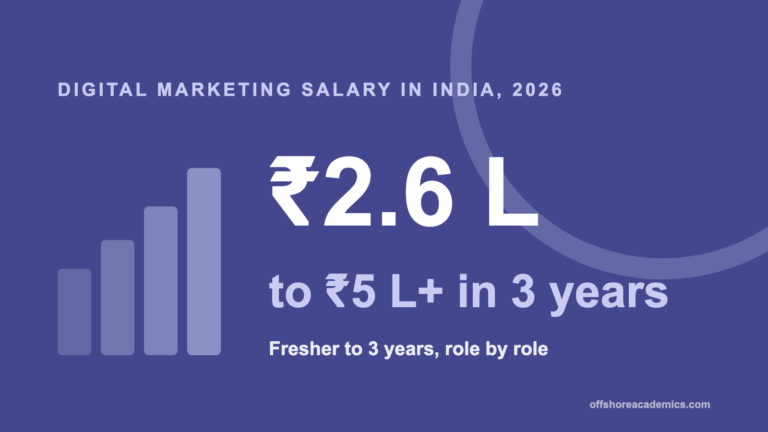
A fresher Digital Marketing Executive in India earns a median of ₹2.6 lakh a year according to 6,700 AmbitionBox profiles for the 0 to 1 year band. SEO Executives start at ₹2.1 lakh, Social Media Executives at ₹2.7 lakh, Content Writers at ₹2.8 lakh. The top 10% of freshers in the same roles earn ₹3.9 lakh, and the difference between the median and the top 10% is almost entirely the case study from the previous section. By year three, specialists reach ₹5 to 6 lakh and performance marketers cross ₹9 lakh. The full breakdown by role, city and experience is in our digital marketing salary in India guide.
c) Mohali and Chandigarh specifically
If you are in the Tricity, you do not need to move for a first job. Digital Marketing Executives in Mohali average ₹2.4 lakh as freshers and ₹3 lakh at 1 to 3 years, within 10% of Delhi on a third of the rent, because the agencies here bill clients in dollars and pounds. Both our digital marketing course in Mohali and the Chandigarh batch place students into those agencies.
Which mistakes keep digital marketing beginners stuck?
Every one of these is fixable this week.
a) Collecting certificates instead of results
Six certificates and no project tells an employer you are good at watching videos. One project with a number tells them you can do the job. Stop at two certificates and start the project.
b) Learning every channel at once
Being able to describe SEO, paid, social, email and analytics is not a skill, it is a table of contents. Employers hire people who can run one channel without supervision. Go deep on one, then add a second in year two.
c) Practising only on demo accounts
Demo accounts have no consequences, so they teach no judgement. Judgement is the entire job. Put ₹300 a day of real money behind one campaign for two weeks and you will learn more than in three months of simulations.
d) Never writing the numbers down
You will run something that works, and eight months later you will not remember the before figure. Keep the results file. It is the raw material of every interview and every raise for the rest of your career.
e) Waiting until you feel ready
Nobody feels ready. Apply at day 60 with one case study and let interviews teach you what you are missing. The beginners who wait for confidence are still waiting a year later; the ones who applied early are on their second job.
How do you choose a digital marketing course if you decide to take one?
If a course fails two of these, the fee is the wrong question.
If, after the free month, you decide a structured programme will get you to the case study faster, judge it on six things and ignore the brochure.
a) Live client projects, not simulations
Ask to see a project from the last batch and ask what the result was. If the answer is a demo account with a fake budget, keep looking. Training that runs inside a working agency, where students sit next to people running real campaigns, is the model we use, and it is the reason the case study exists by the time the course ends.
b) The tools you will be interviewed on
GA4, Search Console, Google Ads, Meta Ads Manager, a rank tracker, an email or WhatsApp platform. They should appear in week one of the syllabus, not the last.
c) One specialisation, chosen early
A course that tours every subject for a week produces generalists. A course built as a major and a minor, where you pick SEO, Google Ads or paid media across Meta and Google early and go deep, produces specialists who start higher.
d) Trainers who still practise
Ask what the trainer ran last month. Someone managing client accounts this quarter is teaching what interviewers will ask this quarter. You can see how that works day to day on our Life at OA page.
e) Placement that is measured
How many of the last batch were placed, in which companies, at what median salary. An institute that tracks these will tell you. One that answers with “100% placement assistance” is describing a promise, not a number.
f) A portfolio you leave with
You should walk out with at least one case study hosted under your own name, not a certificate in a frame. That page is what gets you the interview; everything else in the course was in service of it.
The short version: how to start digital marketing in 2026
Learning how to start digital marketing in 2026 is a 90 day project, not a career gamble. Spend the first month on the customer journey, two free certifications and your own site. Spend the second on one channel and one live project with ₹300 a day or a local business behind it. Spend the third writing the result up and applying with it. The market is growing 22% a year and has 33,420 fresher openings today; the median first salary is ₹2.6 lakh and the top 10% start at ₹3.9 lakh on identical experience. The gap between those two numbers is one documented project.
If you would rather do those 90 days inside a working agency, with live client accounts, a trainer checking every output and a placement team that publishes its numbers, Offshore Academics in Mohali runs 45, 90 and 180 day programmes on exactly that model. Come and sit in on a class before you decide. Bring the results file; we will show you how to fill it.
Frequently asked questions
How do I start digital marketing as a complete beginner with no experience?
Start with the customer journey, not a tool: understand how a real business gets customers from search, social, content and email. Then complete two free certifications (Google Ads Search and Google Analytics 4 on Skillshop), set up your own website with GA4 and Search Console connected, and create Google Ads and Meta Ads Manager accounts. In month two, pick one channel and run one live project, such as ₹300 a day of ads for two weeks or a local business account.
In month three, write the result up as a case study and apply to entry level roles with it. This 90 day plan needs no degree and under ₹7,000 in total.
Can I learn digital marketing for free in 2026?
Yes, the theory is free. Google Skillshop teaches Google Ads and GA4 with free certifications, Meta Blueprint has free courses on Meta Ads Manager, HubSpot Academy covers inbound, content and email, and Semrush Academy covers SEO. Free learning gives you vocabulary, certificates and tool familiarity. It does not give you a live campaign with real money, experienced feedback on your work, a result you can put in an interview, or a placement conversation. Those four things are what a paid course or a self funded project adds, and they are what employers actually hire for.
How long does it take to learn digital marketing and get a job?
About 90 days to be ready for a first application if you spend 10 to 15 hours a week and follow a plan with a live project in it: 30 days of foundation and accounts, 30 days on one channel and one real project, and 30 days writing the case study and applying. Full time courses compress the same phases into 45 to 90 days with a trainer checking each output. Becoming good takes one to three years on the job, but being hireable is a three month project, not a three year one.
Which digital marketing channel should a beginner learn first?
Pick one channel based on how you think, not on which is trendiest. Paid ads (Google and Meta) give the fastest feedback and the highest entry pay, around ₹3.3 lakh for a PPC Executive at 1 to 3 years, and suit people comfortable with numbers. SEO is slower, cheaper to practise, pays less at entry (₹2.1 to 2.5 lakh) and suits patient writers. Social media suits people who like creating and reading comments. Content suits people who already write daily. The only wrong choice is trying to learn all of them at once.
Do I need a degree or a course to get a digital marketing job in India?
No degree is required for most entry level digital marketing roles; on Naukri in September 2026 over 33,000 digital marketing listings accept candidates with zero experience, and employers screen for platform certifications and portfolio work rather than qualifications. A course is not required either, but a good one shortens the path by providing live client projects, feedback and placement support. Judge any course on whether it gives you a documented project with real results, because that project, not the certificate, is what gets you hired.
What is the starting salary for a digital marketing beginner in India?
A fresher Digital Marketing Executive earns a median of ₹2.6 lakh a year in 2026, based on 6,700 AmbitionBox salary profiles for 0 to 1 year of experience. SEO Executives start around ₹2.1 lakh, Social Media Executives ₹2.7 lakh and Content Writers ₹2.8 lakh. The top 10% of freshers in the same roles earn ₹3.9 lakh or more, and the difference is almost always a documented live project. In Mohali and Chandigarh, fresher pay is ₹2.4 to 2.5 lakh, within 10% of Delhi, because local agencies serve US, UK and Australian clients.
.webp)