How to Start Digital Marketing for Beginners in 2026: Zero to First Job in 90 Days
A 90 day plan for digital marketing beginners in 2026: what to learn first, where free learning stops, one live project, the...
Read the article.webp)
Takes 20 seconds. The PDF lands on WhatsApp and email.
No spam. A counsellor may call once to help you pick a batch.
Takes 20 seconds. No obligation.
We never share your number.
Takes 20 seconds.
We never share your number.
Eight digital marketing certificate programs ranked on what you can show an employer afterwards: fees as of September 2026, real time to complete, mode, who each suits, and a verdict.
There are more digital marketing certificate programs on offer in India in 2026 than there are digital marketing jobs in most cities, and the fees run from free to ₹2.5 lakh. Most lists of “the best” are written by the institutes themselves and rank on brand name. This one ranks on a different question: after you finish, what can you show an employer that you could not show before?
We run a programme ourselves, so read our ranking of it with that in mind; it is scored on the same five criteria as everyone else and the criteria are published below. For each of the eight we give the fee as listed in September 2026, the real time to complete, the mode, who it suits, and a verdict. There is a side by side comparison, a guide to choosing by your situation, the evidence on whether certificates change salaries at all, and the mistakes that waste the fee.
If you are brand new to the field, read our guide to starting digital marketing as a beginner first; this article assumes you have decided to get certified and want to know where.
Every digital marketing certificate program on this list will put a line on your CV that a recruiter recognises. That matters, because recruiters shortlist on keywords and a Google or Meta certification is one of the keywords. What no certificate can do is answer the question the hiring manager asks in the second round: “Show me something you ran and what happened.” Programmes that build that answer into the course are worth more than programmes that end with an exam, and the ranking below reflects it.
We scored each programme on five things: whether it includes a live project with real ad spend or real rankings (30%), whether the tools you will be interviewed on are in the syllabus and used on real accounts (20%), how Indian employers read the name on the certificate (20%), cost against what you leave with (15%), and whether placement support reports actual numbers rather than promises (15%). The weights come from what hiring managers at our own agency and partner agencies ask about first when a fresher CV lands.
Earlier versions of this article listed programmes from NIIT, EduPristine, Imarticus and TISS. We removed any programme whose current fee, duration and intake we could not confirm from the institute or a listing site this month, and any programme where the only evidence of outcomes is a testimonial carousel. Full degree programmes above ₹2.5 lakh are also out, because comparing a ₹99 exam with a two year diploma helps nobody.
This is our own programme, so weigh the score accordingly. The reason it sits at the top of our sheet is the first criterion: students work inside live client accounts at Offshore Marketers from the first weeks, on US, UK, Canadian and Australian campaigns, with trainers who are running those accounts this month. The syllabus covers SEO, Google and Meta ads, social, email, content, analytics and AI-assisted workflows, with GA4, Search Console, Google Ads, Meta Ads Manager, Ahrefs, Semrush and Canva Pro included.
You can pick a major from SEO, Meta and Google Ads or performance marketing, and see how a class day runs on the Life at OA page. The format is 12 weeks at 8 to 10 hours a week, live, in the Mohali classroom or online. The institute reports an average starting package of ₹4.2 lakh for placed freshers and a highest offer of ₹8.5 lakh; ask for the batch numbers behind those figures when you visit, because that is the question we tell students to ask everyone.
There is a 7 day free trial with no card required. Details on the digital marketing course page, and the Mohali and Chandigarh pages cover the classroom batches.
Eight courses on Coursera covering the foundations, SEO, paid search and social, email, analytics and e-commerce, built by Google. At $49 a month (about ₹4,100), most people finish in three to six months for ₹12,000 to 25,000, and Coursera lists 75% of graduates reporting a positive career outcome within six months, which is their number and worth treating as a marketing claim. It is the best structured theory course available at the price, the certificate is recognised, and the pace is yours.
What it does not include is anyone checking your work or a live account with money in it, so pair it with the ₹300 a day project from our beginners guide.
Skillshop is Google’s own training platform and the certifications are free, including the exam. Google Ads Search, Display, Video, Shopping and Measurement each take three to four hours, and the GA4 certification is on the same platform. In 2026 a paid media CV without Google Ads Search and GA4 looks unfinished, so do those two this week whatever else you choose. Recruiters filter on them. They prove you know the interface; they do not prove you can spend money well, which is the entire job, so treat them as the entry ticket rather than the qualification. Our Google Ads course is built for the part after the ticket.
Meta Blueprint‘s courses on Ads Manager, campaign structure, audiences and creative are free. The Meta Certified Digital Marketing Associate exam costs $99 (about ₹8,300), is proctored through Pearson VUE, and the credential is valid for two years. It is the one paid exam on this list that is worth its fee for someone targeting a social media or paid social role, because agencies specifically look for it and it is hard enough to mean something. Prepare for two to four weeks on the free courses, then book the exam. The Media Buying Professional exam is the next step once you are running budgets.
HubSpot Academy offers free certifications in Inbound Marketing, Content Marketing, Email Marketing and SEO, each three to six hours of video and a test. They are genuinely useful for vocabulary and for anyone going into content or email roles, and they cost nothing. Employers read them as a nice to have rather than a requirement, which is why they sit mid table. Do the Inbound and Content ones if you are choosing the content channel; skip the rest until a job description asks for them.
MICA is the best known marketing school in India and the certificate carries that name. The programme is 26 core weeks plus 5 weeks per specialisation, online in a blended format, with 12 or more case studies and live projects, career mentorship and resume coaching, at ₹1.11 lakh as listed on Shiksha. Choose it if you are aiming at corporate brand, communication or marketing management roles where the name on the certificate is read by an HR team. Choose something else if your target is an agency executive role in the next six months, where the name matters less than what you can run on day one.
The Simplilearn programme issues a certificate from Purdue University and lists 5 capstones and 15 or more course-end projects across 8 months, online, at ₹1.02 lakh on Shiksha. It is thorough and well produced, and the university name helps in corporate settings and abroad. The capstones are simulated problem statements rather than live client accounts, so the project you walk out with is a classroom project. Working professionals who want a structured programme alongside a job, and a recognised name for it, are the right audience.
Digital Vidya has been running digital marketing training in India since 2009 and the CADMM is its flagship, listed at ₹45,000 for six months of online live instruction in its own fee guide. It sits in the middle of the market on price and is a reasonable structured option for someone who wants live classes without a five figure monthly EMI. As with every programme here, ask to see a project from the most recent batch and what its result was before you pay; the answer tells you more than the brochure.
Whatever you choose, do the free Google Ads Search and GA4 certifications first. They take an afternoon, every recruiter filters on them, and they cost nothing. Paid programmes should be judged on what they add beyond that.
Plot fee against time and two clusters appear. The free and near-free certifications from Google, Meta and HubSpot take hours to weeks. The university-linked programmes cost ₹1 lakh or more and take six to eight months. Digital Vidya sits between them, and an agency classroom programme like ours sits at twelve weeks with a fee that depends on format. Notice that price and hands-on time are not correlated: the most expensive programmes on the list are also the ones with simulated rather than live projects.
If your constraint is time, the long programmes are the wrong tool. Google Skillshop, Meta Blueprint and HubSpot together take under two weeks of evenings, and combined with a self-run ₹300 a day campaign you can be applying inside two months. The eight month programmes suit people with a job who are building a credential alongside it. A twelve week agency programme is the middle path: a fixed end date, the live project built in, and applications starting before the certificate is printed.
This is the comparison that matters. A live case study with real numbers is checked in every agency interview. A university name is checked by corporate HR. A platform certification is checked by recruiter software. Structured theory is checked by nobody directly but shows up in how you talk. Decide which of these your target job checks first, and pick the programme that produces it.
Do the free platform certifications in month one, then get into live accounts by whatever route you can: an agency-run programme, a local business you take on for free, or your own ₹300 a day campaign. Agencies hire executives on what they can run unsupervised, and the salary data in our salary guide shows the top 10% of freshers earning ₹3.9 lakh against a ₹2.6 lakh median on identical experience. The difference is the case study, not the certificate.
Clients do not ask freelancers for certificates. They ask what you did for someone like them. The Google Ads and Meta certifications are still worth doing because partner directories and some marketplaces list them, but your real credential is two documented results, even small ones, from local businesses. Skip the ₹1 lakh programmes; put that money into a year of tools and a small ad budget for your own experiments.
If you own a business, you need breadth and judgement rather than depth in one channel, so the Google Career Certificate plus a couple of HubSpot courses is the right shape: three months, under ₹25,000, and you come out able to tell whether the agency you hire is doing a good job. Do not do a six month executive programme to learn a job you will delegate.
If you are leaving another field with savings to invest and your target is a corporate marketing team, the MICA or Purdue name does real work on a CV that otherwise says accountant or engineer. If your target is an agency, the name matters less and the live project matters more, so a twelve week agency programme gets you there faster and cheaper. In both cases, add a documented project; the name earns the interview and the project earns the offer.
When a fresher CV lands with us or with the agencies we place into, the first thing anyone looks for is a result: a campaign, a page, a channel, and what changed. Google Ads and GA4 certifications are next, because recruiter software filters on them. Then which tools you have touched on a real account. The institute name comes fourth and matters most for corporate HR teams. The number of certificates is the thing that is checked least, and a CV with six of them and no project reads as someone who prefers watching to doing.
AmbitionBox data for 2026 puts the median fresher Digital Marketing Executive at ₹2.6 lakh and the top 10% at ₹3.9 lakh, on the same title and the same zero years of experience. If certificates drove pay, that gap would track certificate count. It does not. It tracks whether the person can show a result, which is why the programmes that build one in are ranked higher here even when they cost less. Our guide to the skills that raise salaries fastest covers what to add after the first job.
Free platform certifications are always worth it; they cost an afternoon and recruiters look for them. Paid programmes are worth it when they leave you with either live work you can show or a name your target employer reads, and ideally both. A programme that ends with a certificate and nothing to show is not worth it at any price, including free, because the time was the real cost.
If a paid programme’s syllabus is a list of platforms, it is re-recording what Google and Meta teach free. Pay for the things the platforms cannot give you: a real account, someone checking your decisions, and a placement conversation.
Names help in specific rooms: corporate HR, overseas applications, a career switch where your CV needs reassurance. They do nothing in an agency practical round. Know which room you are aiming for before you pay ₹1 lakh for the name.
Two platform certifications and one documented project beats eight certifications every time. If you notice yourself enrolling in a fourth course, that is the moment to stop and run something instead.
Before paying anyone, including us, ask three questions: how many of the last batch were placed, in which companies, and at what median salary. An institute that tracks these will tell you. Ours publishes them on the placements page; hold everyone on this list to the same standard.
Do the free Google Ads Search, GA4 and Meta Blueprint certifications this week; they are the entry ticket for every digital marketing job in 2026. Then choose one paid programme by what your target job checks: an agency-run classroom programme with live client accounts if you want an agency job fast, MICA or Purdue if you need a name for corporate HR or a career switch, the Google Career Certificate if you are a business owner who needs breadth, and none of them if you are freelancing, where two client results are the only credential.
Whatever you pick, leave with a documented project, because the salary data says that is what separates a ₹2.6 lakh first offer from a ₹3.9 lakh one.
If you want to see the agency model before deciding, Offshore Academics runs a 7 day free trial with no card required. Sit in on a class, look at a live account, and ask for the batch numbers. Then compare us against everyone else on this list with the same questions.
It depends on the job you want. For an agency executive role within a few months, an agency-run programme with live client accounts, such as the Offshore Academics 12 week programme, produces the case study agencies hire on. For corporate marketing roles or a career switch, the MICA with upGrad Advanced Certificate (₹1.11 lakh, 31 weeks) or the Purdue with Simplilearn PGP (₹1.02 lakh, 8 months) carry names HR teams recognise. For everyone, the free Google Ads Search, GA4 and Meta Blueprint certifications are expected on the CV and should be done first.
Yes, as a structured theory course. It costs $49 a month on Coursera, most people finish in three to six months for ₹12,000 to 25,000, it covers foundations, SEO, paid ads, social, email and analytics, and the Google name is recognised. What it lacks is a live account with real money and anyone checking your work, so pair it with a self-run ₹300 a day campaign or a local business project to have something to show in interviews.
Free certifications from Google Skillshop, Meta Blueprint and HubSpot Academy get you past recruiter filters and are expected on any entry level CV in 2026. On their own they rarely get you hired, because interviews for agency roles turn on something you have run and what happened. Free certifications plus one documented project, even a small one, is enough for many entry level roles. Free certifications plus nothing usually is not.
Free for the platform certifications from Google, Meta and HubSpot; the Meta Certified Digital Marketing Associate exam is $99 (about ₹8,300). The Google Career Certificate on Coursera runs $49 a month, about ₹12,000 to 25,000 in total. Structured Indian programmes run from ₹45,000 (Digital Vidya CADMM, 6 months) to ₹1.02 lakh (Purdue with Simplilearn, 8 months) and ₹1.11 lakh (MICA with upGrad, 31 weeks). Agency classroom programmes such as Offshore Academics quote fees on request and offer a free trial.
Recruiters do, because their software filters on Google Ads and GA4 certifications and hiring managers expect them on a fresher CV. Beyond that filter, hiring managers care about a result you can describe with numbers, the tools you have used on real accounts, and for corporate roles the institute name. The number of certificates you hold is the thing checked least; six certificates and no project reads as a preference for watching over doing.
Not on its own. AmbitionBox 2026 data shows fresher Digital Marketing Executives earning ₹2.6 lakh at the median and ₹3.9 lakh in the top 10% with identical experience, and that gap tracks documented results rather than certificate count. Certificates raise your salary indirectly when the programme includes live work that becomes a case study, or when a recognised name gets you into a higher paying corporate interview you would not otherwise have had.
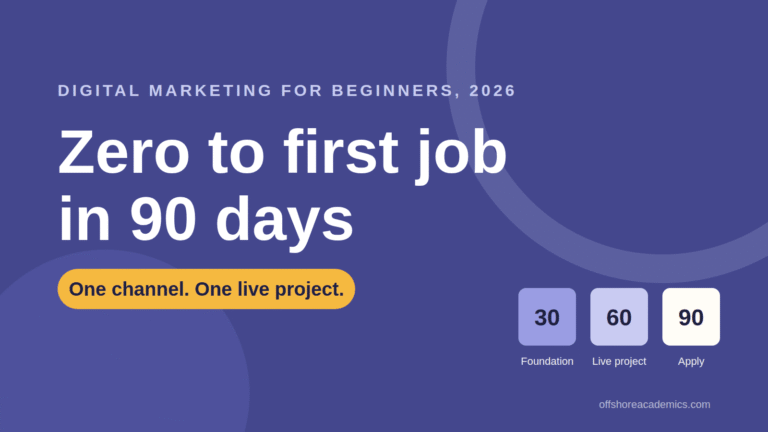
A 90 day plan for digital marketing beginners in 2026: what to learn first, where free learning stops, one live project, the...
Read the article
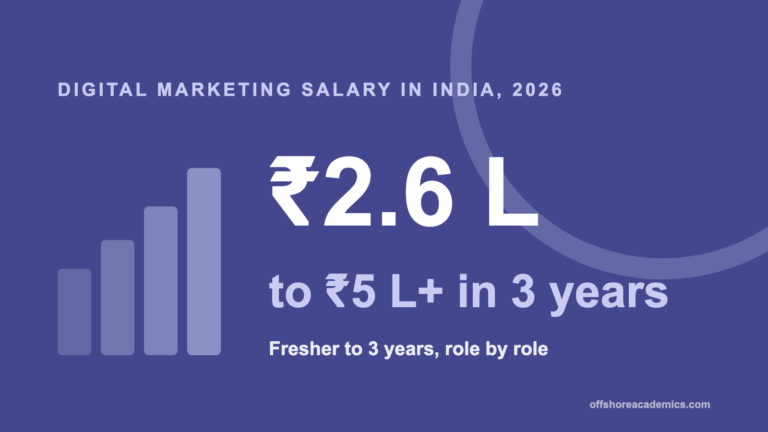
Real 2026 digital marketing salary in India by role: fresher to 3 years, Mohali and Chandigarh vs metros, and the path from...
Read the article
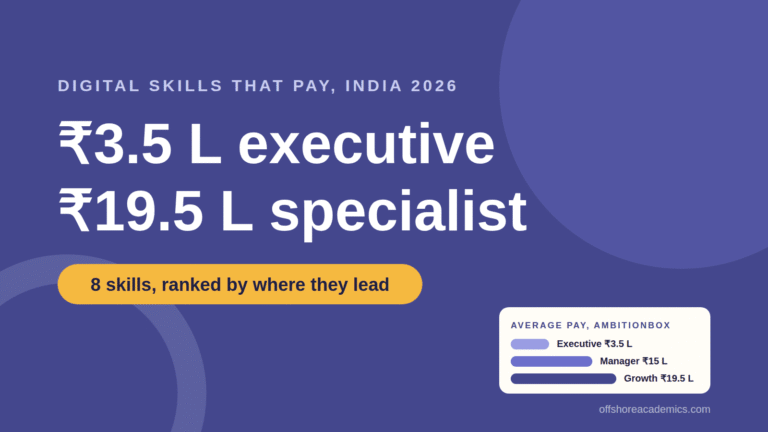
Eight digital skills ranked by the pay ceiling they lead to, with AmbitionBox 2026 figures for the entry role, the specialist role...
Read the article