Takes 20 seconds. The PDF lands on WhatsApp and email.
No spam. A counsellor may call once to help you pick a batch.
How do we reach you?
Takes 20 seconds. No obligation.
We never share your number.
Your details
Takes 20 seconds.
We never share your number.
Link copied
8 Digital Skills That Will Increase Your Salary in India (2026 Data)
Eight digital skills ranked by the pay ceiling they lead to, with AmbitionBox 2026 figures for the entry role, the specialist role and the top 10%, plus how long each takes to learn and how you prove it.
S
Author: Shiva Ji|16 min read|August 19, 2025
In this article
The digital skills that increase your salary are not the ones with the most YouTube tutorials. They are the ones that sit closest to money. A Digital Marketing Executive in India averages ₹3.5 lakh a year across 47,000 salary profiles on AmbitionBox. A Performance Marketing Manager averages ₹15 lakh. A Growth Marketing Manager averages ₹19.5 lakh. Same industry, same tools open on the laptop, a five times difference in pay, and the whole gap is explained by which skill the person owns and what they can prove with it.
This is an updated 2026 ranking of the eight digital skills that move salaries in India, each one scored on the same three numbers: what the entry role pays, what the specialist role pays, and what the top 10% in that specialist role earn. All figures are AmbitionBox averages read in September 2026, with the sample size shown, so you can weigh them yourself. For each skill you also get the realistic time to become hireable and the one piece of proof that gets you paid for it.
Ranked by pay ceiling, the eight digital skills that increase salary in India are: paid media, growth and CRO, marketing analytics, marketing automation and AI, email and CRM, content, SEO, and social media.
Paid media has the steepest ladder: PPC Executive ₹4 lakh, Performance Marketing Manager ₹15 lakh, top 10% ₹22 lakh, all on AmbitionBox 2026 data.
Analytics and automation pay ₹7 to 10 lakh at specialist level with fewer than 700 profiles each, which means demand is outrunning supply.
SEO and social media pay least at entry (₹2.7 and ₹3.6 lakh) but are the most common first jobs; their money is in the specialist titles they lead to, not in the executive title itself.
Skills raise salaries only when they come with proof: a channel you owned, a number you moved, and a written record. The same skill without proof pays the executive rate.
Learn one skill deep, add an adjacent one in year two, and switch or negotiate at year three with numbers. That is how a ₹3.5 lakh executive becomes a ₹7 lakh specialist.
How we ranked the digital skills that increase your salary in 2026
a) The data behind every number
Real titles, real sample sizes, read this month.
Most “highest paying digital skills” articles quote a range like ₹3 to 6 lakh for freshers and ₹12 to 30 lakh for seniors with no source, which tells you nothing. Every number here is tied to a job title on AmbitionBox, India’s largest self-reported salary database, read in September 2026, with the number of profiles behind it. The Digital Marketing Executive figure rests on 47,000 profiles; some specialist titles rest on a few hundred, and we say so, because a small sample with a high average is itself a signal about scarcity.
b) Two numbers per skill: the entry pay and the ceiling
Choose a skill by its ceiling, not by what it pays in month one.
A skill has two prices. What the entry job pays, which is what most articles report, and what the specialist role pays three to five years later, which is what should actually drive your choice. SEO is the clearest example: the executive title averages ₹2.7 lakh, near the bottom of the list, but the top 1% of SEO Executives at 3 to 6 years earn ₹8.1 lakh. We rank on the ceiling, show both numbers, and let you decide how patient you are.
c) What a skill means to an employer
Tool familiarity is the entry ticket. The result is the skill.
Before the list, one definition. To an employer, a skill is not knowing a tool. It is a result you can produce again for their business. “I know Meta Ads Manager” gets you an executive interview. “I ran ₹1.2 lakh of Meta spend for a clinic and took cost per lead from ₹410 to ₹190 in eight weeks” gets you the specialist salary. Every skill below is described that way: the tool, then the result, then how you prove it.
The 8 digital skills that increase your salary, ranked by ceiling
Growth and paid media lead on ceiling. Analytics and automation lead on scarcity.
The chart shows all eight at once: the dark bar is the entry role, the mid bar is the specialist role, the light bar is the top 10% of that specialist role. Two things stand out. The skills closest to revenue, paid media and growth, have the highest ceilings. The skills that involve data, analytics and automation, have the highest entry pay, because almost nobody in marketing can do them.
Paid media and performance marketing
Paid media and performance marketing: entry ₹4.0 L, specialist ₹15.0 L, top 10% ₹22.0 L.
Paid media is the skill with the steepest ladder in Indian digital marketing. A PPC Executive averages ₹4 lakh on 5,000 profiles. A Performance Marketing Manager, the same skill with a budget attached, averages ₹15 lakh on 2,800 profiles, with the top 10% at ₹22 lakh and the top 1% at ₹36.9 lakh. The jump happens because the person is directly responsible for money in and money out, which makes their value easy to measure and easy to negotiate on.
Learn Google Ads Search first, then Meta, then measurement; our performance marketing course and Meta and Google Ads programme are built around running live budgets from the first weeks. Proof is a line like “managed ₹6 lakh a month across three accounts, ROAS from 2.1 to 3.4”.
Growth marketing and conversion rate optimisation
Growth marketing and conversion rate optimisation: entry ₹4.2 L, specialist ₹19.5 L, top 10% ₹29.1 L.
Growth marketing is the highest ceiling on the list: Growth Marketing Managers average ₹19.5 lakh on 913 profiles, with the top 10% at ₹29.1 lakh. It is not an entry skill. It is what paid media, analytics and CRO become when one person owns the whole funnel, from first click to repeat purchase, and is judged on customer acquisition cost and retention. The entry point is usually a specialist title at 1 to 3 years, averaging ₹4.2 lakh. CRO is the learnable core: landing page tests, form changes, offer tests, each with a measured lift.
Start there, on any account you touch, and keep every test result. Two years of documented tests is a growth CV.
Marketing analytics
Marketing analytics: entry ₹7.3 L, specialist ₹9.3 L, top 10% ₹16.5 L.
Analytics has the highest entry pay of any marketing skill: a Digital Analyst averages ₹7.3 lakh on 654 profiles, double what a Digital Marketing Executive earns, and a Marketing Analyst averages ₹9.3 lakh with the top 10% at ₹16.5 lakh. The reason is scarcity. Most marketers can read a report; very few can build one, connect GA4 to ad platforms, and tell a founder which channel to cut. Learn GA4 properly, then Looker Studio, then enough spreadsheet skill to join two data sources. Proof is a dashboard that a business used every week and one decision it changed, with the number that moved.
Marketing automation and AI workflows
Marketing automation and AI workflows: entry ₹5.8 L, specialist ₹10.3 L, top 10% ₹16.9 L.
Marketing Automation Specialists average ₹10.3 lakh on 648 profiles, top 10% at ₹16.9 lakh, and it is the skill that AI has changed most since this article was first written. In 2026 the job is building workflows: lead scoring, WhatsApp and email sequences, CRM triggers, and AI steps that draft, classify or personalise inside those workflows. “Knows ChatGPT” is not a skill and does not appear on any salary page. “Built the onboarding sequence that lifted trial to paid from 4% to 7%” is.
Learn one platform deeply, HubSpot or Zoho or Mailchimp with automations, then add AI steps where they save a human hour. Our digital marketing course teaches AI as part of every channel rather than as a separate subject, for this reason.
Email marketing and CRM
Email marketing and CRM: entry ₹3.8 L, specialist ₹7.3 L, top 10% ₹10.0 L.
Email is the quiet earner. Email Marketing Specialists average ₹3.8 lakh at 1 to 3 years and ₹7.3 lakh at 3 to 6 years, with the top 10% at ₹10 lakh in that band, on 700 profiles. It doubles in three years because a well-run list is the cheapest revenue a business has, and few people run one well. In India it now includes WhatsApp, which behaves like email with ten times the open rate. Learn segmentation, deliverability and one CRM. Proof is revenue per send and list growth over a quarter, numbers most marketers have never been asked for and never kept.
Content marketing
Content marketing: entry ₹4.1 L, specialist ₹4.4 L, top 10% ₹6.5 L.
Content Writers average ₹4.1 lakh across 29,000 profiles, more than SEO or social executives, and the spread is wide: the top 10% at 3 to 6 years earn ₹6.5 lakh and the top 1% ₹13.5 lakh. The people at the top are not better writers. They write for search intent and conversion, and they can show a page that ranks and a page that produced leads. AI has flooded the bottom of this market with generic text, which has raised the price of writers who can produce something a reader trusts.
Learn keyword intent, page structure and conversion copy; our SEO course covers the search half. Proof is a URL with traffic and leads attached.
Search engine optimisation
Search engine optimisation: entry ₹2.7 L, specialist ₹3.3 L, top 10% ₹4.5 L.
SEO is the most common first job and the lowest paid executive title: ₹2.7 lakh average on 20,000 profiles, ₹3.3 lakh at 3 to 6 years. It is on this list because of where it leads. The top 1% of SEO Executives at 3 to 6 years earn ₹8.1 lakh, three times the average, and SEO is the usual route into content strategy, analytics and growth roles that pay far more.
In 2026 the skill has changed: AI Overviews answer many queries before a click, so SEO is now as much about being cited as being ranked, and the people who understand that are scarce. Learn technical basics, intent and content; proof is organic traffic and leads before and after on a site you are allowed to name.
Social media marketing
Social media marketing: entry ₹3.6 L, specialist ₹4.0 L, top 10% ₹5.7 L.
Social Media Executives average ₹3.6 lakh on 9,200 profiles, ₹4 lakh at 3 to 6 years, top 10% ₹5.7 lakh. It pays more than SEO at entry and less at the top, because organic social on its own is hard to tie to revenue. The salary jump comes from pairing it with paid social, which moves you onto the paid media ladder above, or with short-form video and creative strategy for brands that sell through Instagram. Learn one platform’s organic and paid side together; proof is an account you grew, with enquiries, plus one paid campaign with a cost per result.
💡
Pro Tip
Every card above ends with a proof line. Start a results file today with the proof line for the skill you already have, even if the numbers are small. Interviews and salary reviews are conversations about that file.
Which digital skill should you learn first?
a) If you are a fresher or still in a course
One channel, owned, by month six.
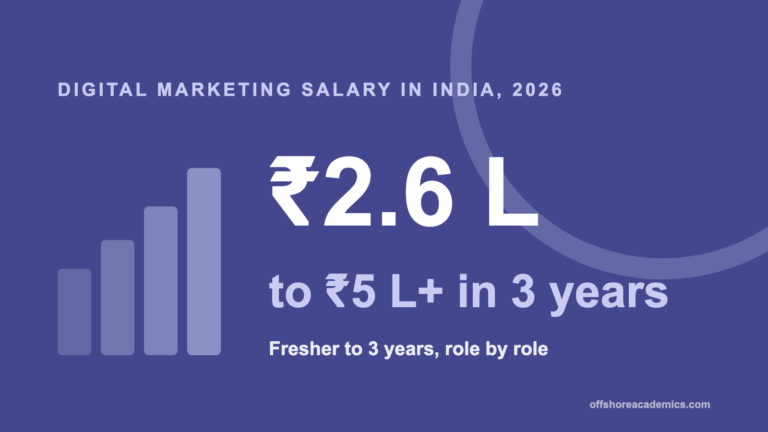
If you are new, pick paid media if you can put ₹300 a day behind a campaign for two weeks, because nothing else teaches judgement as fast and nothing else has a steeper salary ladder. If you cannot fund spend, start with SEO or content on a site you own, then add paid in your first job. Either way the target is one channel owned by month six, and the pay for that is in our digital marketing salary in India guide: ₹2.6 lakh at the median, ₹3.9 lakh for the freshers who arrive with a project.
b) If you have one to three years of experience
The title jump comes from a second skill that shares a result with the first.
At one to three years the goal is the title jump from Executive to Specialist, which on AmbitionBox is the difference between ₹3.5 lakh and ₹7.1 lakh on average. It comes from adding one adjacent skill that shares a result with the one you have: paid media plus analytics, SEO plus content, social plus paid social, email plus automation. Two skills that touch the same number make you the person who owns that number, which is what the specialist title means.
c) If you are switching from a non-marketing job
Your old job already trained you for one of these. Start there.
If you are switching careers, enter through the skill your old job already trained you for. Salespeople think in cost per lead and should start with paid media and CRM. Finance and operations people think in spreadsheets and should start with analytics, which also pays the most at entry. Writers and teachers think in explanations and should start with content and SEO. Our guide to the best digital marketing certificate programs covers which programme fits a funded switch.
How do you turn a digital skill into a higher salary?
a) Own one channel, not a task list
The pay band follows ownership, not effort.
The same skill pays ₹3 lakh as an Executive and ₹4.2 lakh as a Specialist at the same experience, and the difference is scope. Executives run tasks inside a channel. Specialists own the channel: the budget, the creative, the reporting, and the target. Ask for the whole thing as early as you can, even on a small account. Ownership is what turns a skill into a salary conversation.
b) Keep the numbers from day one
The results file is the raw material of every raise.
You will run something that works. Without a record, by the next appraisal you will not remember the before figure, and a result you cannot state is a result you did not have. Keep a results file: date, what you changed, the number before, the number after, a screenshot in a folder. It becomes your case studies, your LinkedIn, and the first page of every negotiation.
c) Stack an adjacent skill in year two
Add depth that shares a result, not breadth that dilutes one.
In year two, add one skill that touches the same result as your first. Paid plus analytics means you run the spend and can prove what it did. SEO plus content means you find the demand and write what captures it. Do not add a fourth channel; breadth at this stage makes you a generalist, and generalists are paid the executive rate into their third year.
d) Switch or negotiate at year three, with numbers
Never anchor to your last salary. Anchor to the results file.
By year three, with one owned channel, one adjacent skill and a results file, you are the specialist the data describes. Internal raises typically land at 15 to 20%. A documented switch typically lands at 40 to 60%, which is what takes a ₹4 lakh salary past ₹6 lakh. In either case, anchor the conversation to the market rate for what you can prove, never to your current salary, because the moment you quote your last figure you have capped the raise at whatever percentage the employer finds reasonable.
Which mistakes stop digital skills from raising your salary?
a) Learning tools instead of outcomes
Every salary page is a list of outcomes, not tools.
Google Skillshop and Meta Blueprint certifications are free, expected on every CV, and prove that you can find the buttons. They do not raise pay on their own. Pay follows what you did with the buttons. Do the certifications in a weekend, then spend your time producing an outcome you can name.
b) Trying to learn all eight
Depth in one beats a summary of eight.
A person who can describe all eight skills is a table of contents. A person who can run one without supervision is a specialist. Learn one deep, add one adjacent, and let the rest stay at the level of “knows what it is”.
c) Ignoring analytics because it looks technical
The most avoided skill is the best paid entry skill.
Analytics is avoided by most marketers because it looks technical, which is exactly why Digital Analysts average ₹7.3 lakh while executives average ₹3.5 lakh. It is GA4, Looker Studio and a spreadsheet, learnable in eight weeks. Whatever your first skill, add enough analytics to prove your own results; it doubles as the second skill from the section above.
d) Treating AI as a skill on its own
AI multiplies a skill. It is not one.
There is no salary page for “AI marketer”. AI raises pay inside a channel: automation specialists who build AI steps into workflows, analysts who use it to clean data, writers who use it for research and drafts they then fix, paid media managers who know when to override Smart Bidding. Learn the channel first, then learn where AI saves an hour inside it. That order is the whole difference between a prompt hobbyist and a ₹10 lakh automation specialist.
The short version: the digital skills that increase your salary
The digital skills that increase your salary in India in 2026, ranked by ceiling, are paid media (₹4 lakh to ₹15 lakh to ₹22 lakh), growth and CRO (to ₹19.5 lakh), marketing analytics (₹7.3 lakh at entry), marketing automation and AI (₹10.3 lakh), email and CRM (₹3.8 lakh to ₹7.3 lakh in three years), content (₹4.1 lakh with a ₹13.5 lakh top end), SEO (₹2.7 lakh entry, ₹8.1 lakh top 1%) and social media (₹3.6 lakh).
Pick one by its ceiling and your temperament, own the channel by month six, keep a results file, add one adjacent skill in year two, and negotiate at year three with numbers. That is the route from the ₹3.5 lakh executive average to the ₹7.1 lakh specialist average, and it is open to anyone willing to be measured.
If you want to build the first skill inside a working agency, on live client accounts with a trainer checking the results file every week, Offshore Academics in Mohali runs 12 week programmes on that model, with a 7 day free trial. Ask for the placement numbers before you decide, the way we would tell you to ask anyone.
Frequently asked questions
Which digital skill pays the most in India in 2026?
By pay ceiling, growth marketing and paid media pay the most: Growth Marketing Managers average ₹19.5 lakh and Performance Marketing Managers ₹15 lakh on AmbitionBox 2026 data, with top 10% figures of ₹29.1 lakh and ₹22 lakh. By entry pay, marketing analytics pays the most: Digital Analysts average ₹7.3 lakh against ₹3.5 lakh for a Digital Marketing Executive. Both routes start with owning one channel and keeping a record of the results you produce.
Which digital skill should a beginner learn first to increase salary?
Paid media, if you can fund ₹300 a day of ad spend for two weeks, because it gives the fastest feedback and leads to the steepest salary ladder (PPC Executive ₹4 lakh, Performance Marketing Manager ₹15 lakh). If you cannot fund spend, start with SEO or content on a site you own and add paid media in your first job. Analytics is the best second skill for anyone, because it lets you prove your own results and pays ₹7.3 lakh at entry on its own.
Do digital marketing certifications increase salary?
Not by themselves. Free certifications from Google Skillshop and Meta Blueprint are expected on every CV and get you past recruiter filters, but AmbitionBox data shows freshers with identical experience earning anywhere from ₹2.5 lakh to ₹7.5 lakh, and that spread tracks documented results, not certificate count. A certification raises salary when it comes with a live project you can describe with numbers.
Is SEO still a high paying digital skill in 2026?
At entry, no: SEO Executives average ₹2.7 lakh, the lowest on this list, and ₹3.3 lakh at 3 to 6 years. At the top, yes: the top 1% of SEO Executives at 3 to 6 years earn ₹8.1 lakh, and SEO is the common route into content strategy, analytics and growth roles that pay ₹10 lakh and above. In 2026 the skill includes being cited in AI Overviews as well as ranking, and people who understand that are scarce.
Is AI a digital skill that increases salary?
AI raises pay inside a channel rather than as a skill of its own; no salary page lists “AI marketer” as a title. Marketing Automation Specialists, who build AI steps into email, WhatsApp and CRM workflows, average ₹10.3 lakh with the top 10% at ₹16.9 lakh. Analysts, writers and paid media managers who use AI well inside their channel earn more than those who do not. Learn the channel first, then learn where AI saves an hour inside it.
How long does it take to learn a digital skill well enough to get paid for it?
Eight to twelve weeks to be hireable in one channel if you are running a real project, not a simulation: paid media on a ₹300 a day budget, SEO or content on your own site, analytics on any account you can access. One to two years to own the channel and be paid the specialist rate. A structured programme with live client accounts, such as the 12 week Offshore Academics course, compresses the first stage and produces the case study that the specialist salary depends on.
.webp)